Why So Many Flagstaff Homes Have Basements (And What That Means for Insulation)
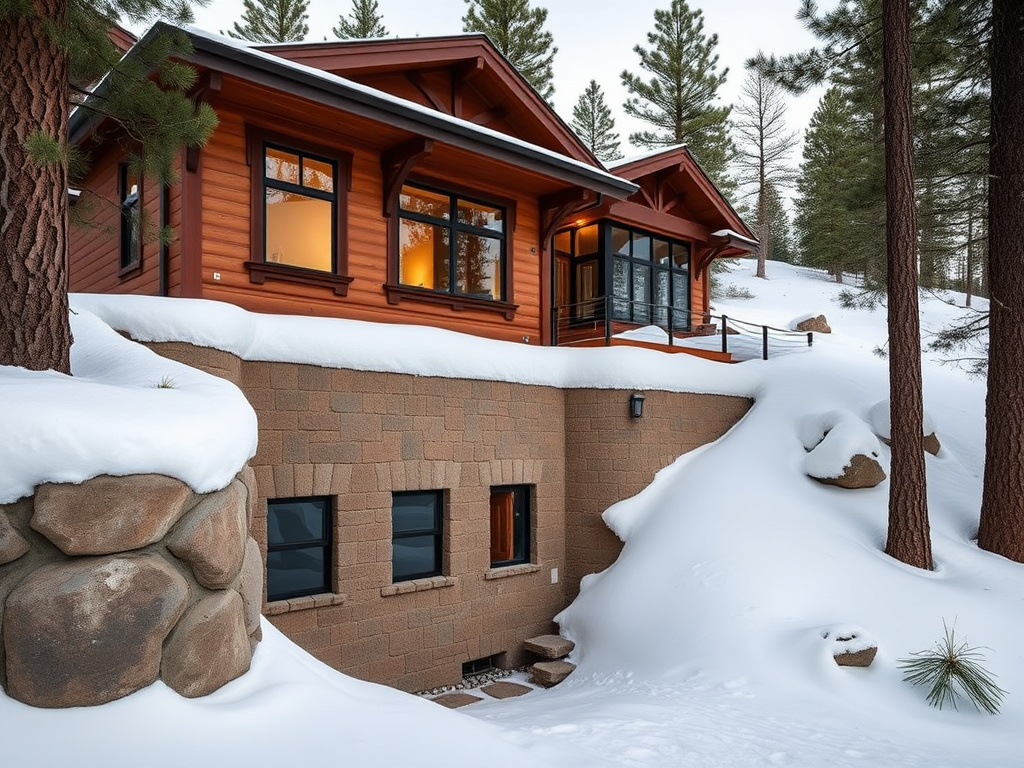
If you've owned a home in a flat, low-desert Arizona city before moving to Flagstaff, a full basement under your current house might be a genuinely new experience. It's not a design preference — it's a direct result of Coconino County's building code. Footings here have to sit below the local frost line, and at Flagstaff's roughly 6,910-foot elevation, that frost line runs considerably deeper than anywhere in low-desert Arizona. Once a builder has to dig that deep for the footings anyway, a full basement or a tall crawl space becomes the more practical foundation choice, rather than a shallow slab-on-grade.
Why frost depth drives foundation type
A slab-on-grade foundation works fine in a climate where the ground doesn't freeze deeply — the kind of conditions common in Phoenix or Mesa but nonexistent in Flagstaff. Where the frost line runs deep, footings have to go down below it regardless of what sits above grade, or the foundation risks frost heave — the ground literally shifting and cracking the structure as it freezes and thaws. Once you're already excavating to that depth, a full basement or tall crawl space is often barely more expensive than a shallow foundation, and far more useful. This shows up across a wide range of Flagstaff-area homes, from older Southside and downtown houses to newer construction ringing NAU and out toward Doney Park.
What an unsealed basement or crawl space actually costs you
- Cold floors — an unsealed basement or crawl space lets deep winter cold settle directly under your living space, and that cold transfers straight up through an uninsulated floor assembly
- Rim-joist heat loss — the band of framing where your foundation wall meets your first-floor exterior wall is often the thinnest, least-insulated part of the whole envelope
- Higher heating runtime — the furnace works harder to compensate for heat loss through the floor and rim joist all winter long
- Moisture and humidity issues — basements and crawl spaces are often where condensation, musty odor, and on older homes, framing issues first appear
- Drafts at floor level — occupants often describe this as 'cold ankles' near exterior walls, even with the thermostat set normally
The rim joist: the part everyone forgets
The rim joist doesn't get much attention because it's out of sight, tucked at the top of the foundation wall behind whatever's stored in the basement or crawl space. But it's one of the most disproportionate sources of heat loss in a cold-climate home — a thin strip of wood framing directly exposed to outside temperature, often insulated with nothing more than a loosely fit fiberglass batt, if that. In a heating-dominated Zone 5B climate like Flagstaff's, an uninsulated rim joist is a genuine, ongoing energy drain, not a minor detail.
What actually fixes it
Closed-cell spray foam applied to basement or crawl-space walls and the rim joist insulates and air-seals the space while resisting the moisture that's common in a below-grade or semi-below-grade assembly. We typically recommend closed-cell specifically for this application, given its vapor-retarding properties and resistance to Flagstaff's freeze-thaw cycling. Some basements and crawl spaces also need vapor-barrier work addressed at the same time — we assess that honestly rather than just spraying foam over an existing moisture problem.
What to expect from the project
Basement and crawl-space insulation is typically one of the more contained projects we do — a half-day to full-day job depending on square footage and access, sometimes extending to two days on a larger whole-home job. Clearance and hatch access vary a lot by home, which is part of why we assess in person rather than quote blind. It's also one of the projects homeowners notice fastest, since cold floors and drafty baseboards in the rooms directly above go from a daily annoyance to genuinely comfortable.
Basements, crawl spaces, and Flagstaff's rental and student housing stock
A meaningful share of Flagstaff's housing near NAU and in the older Southside and downtown neighborhoods functions as rental property, and basements or crawl spaces in this segment of housing stock are disproportionately likely to have gone untouched since the home was originally built. For landlords, an uninsulated rim joist or crawl space isn't just a tenant comfort complaint — it's an ongoing utility-cost and moisture-risk issue that tends to get worse, not better, with time. The same assessment and closed-cell approach applies whether the home is owner-occupied or a rental; what changes is usually just the scheduling around tenant turnover.
Frequently asked questions
The most noticeable improvement is usually in the room(s) directly above — cold floors and drafts specifically. There's typically some whole-home benefit too, since a leaky basement or crawl space affects overall air-sealing, but the fastest, most obvious difference shows up in the specific rooms sitting over the treated area.
No — it depends on the era the home was built and the lot. Coconino County's frost-depth requirements mean both full basements and tall crawl spaces are common, and the choice often comes down to builder preference or the specific site, unlike a flat market where slab-on-grade dominates almost entirely.
Ready for a free quote?
Tell us about your home and we'll build a clear, no-pressure quote.